


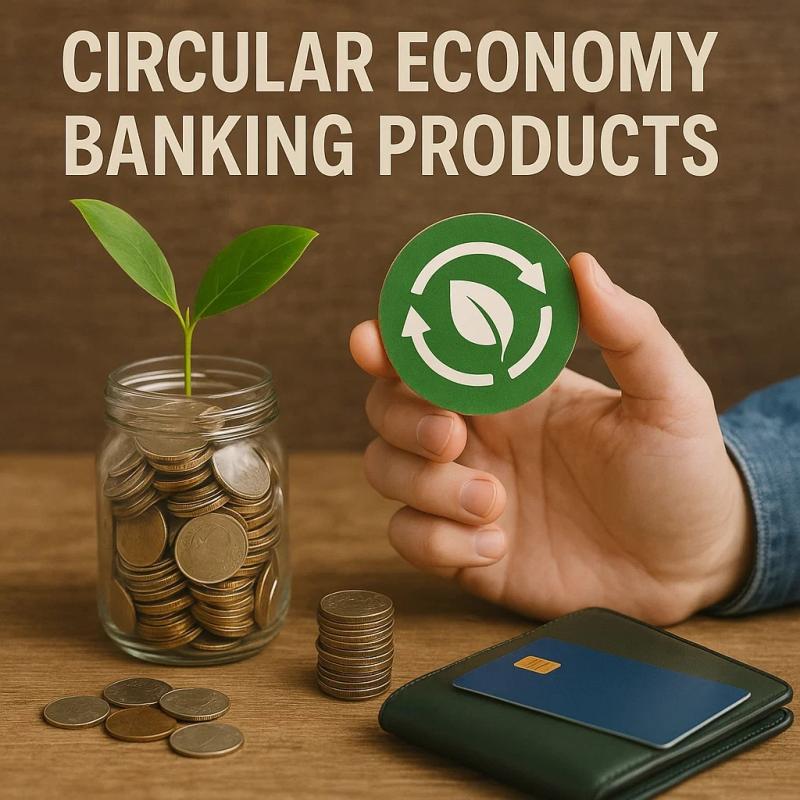
Circular Economy Banking Products Market
HTF MI recently introduced Global Circular Economy Banking Products Market study with 143+ pages in-depth overview, describing about the Product / Industry Scope and elaborates market outlook and status (2025-2032). The market Study is segmented by key regions which is accelerating the marketization. At present, the market is developing its presence.
Major companies in Circular Economy Banking Products Market are:
Triodos Bank (Netherlands), ING Group (Netherlands), BNP Paribas (France), Barclays (UK), HSBC (UK), Crédit Agricole (France), Bank of America (US), JPMorgan Chase (US), Citi (US), Santander (Spain), BBVA (Spain), Rabobank (Netherlands), Standard Chartered (UK), ANZ (Australia), Westpac (Australia), Commonwealth Bank (Australia), DBS Bank (Singapore), OCBC Bank (Singapore), UOB (Singapore), SEB (Sweden), Nordea (Finland), Swedbank (Sweden), KBC Group (Belgium), Erste Group (Austria), Société Générale (France), Bank Australia (Australia)
Request PDF Sample Copy of Report: (Including Full TOC, List of Tables & Figures, Chart) @
👉 https://www.htfmarketreport.com/sample-report/4353833-circular-economy-banking-products-market?utm_source=Sweety_OpenPR&utm_id=Sweety
According to HTF Market Intelligence, the Global Circular Economy Banking Products market is projected to grow from 7 Billion USD in 2024 to 25 Billion USD by 2032, at a CAGR of 17.25%. from 2025 to 2032.
The following Key Segments Are Covered in Our Report
By Type
Green savings accounts , Recycled‒material debit cards , Repair/refurb finance , Take‒back program loans , Sustainability‒linked loans , Deposit‒for‒reuse accounts , Carbon footprint trackers , Impact/green bonds , Circular leasing , Trade‒in escrow services
By Application
SME circular projects , Consumer green purchases , Manufacturers under EPR , Retailers take‒back , Municipal waste‒to‒value , Startups & innovation , Large‒corporate sustainability finance
Definition:
Circular economy banking products are financial services and instruments designed to support sustainable, regenerative, and resource-efficient economic models. Unlike traditional banking products that primarily fund linear “take-make-dispose” business models, circular economy products channel capital into activities that promote reuse, recycling, remanufacturing, and sustainable resource management. These products include green loans, sustainability-linked bonds, circular credit lines, investment funds, and insurance solutions that incentivize businesses and individuals to adopt eco-friendly practices.
Market Trends:
Green bonds are gaining popularity among investors , Carbon footprint tracking tools are being integrated into banking apps , Circular leasing models are emerging as new financing options , Digital green wallets are providing eco-friendly payment solutions
Market Challenges:
Measuring circular impact remains complex and inconsistent , Consumer awareness of sustainable banking products is still limited , Complex underwriting processes can slow adoption , Regulatory hurdles may vary across regions
Dominating Region:
Europe
Fastest-Growing Region:
Asia Pacific
Have a query? Market an enquiry before purchase 👉 👉 https://www.htfmarketreport.com/enquiry-before-buy/4353833-circular-economy-banking-products-market?utm_source=Sweety_OpenPR&utm_id=Sweety
The titled segments and sub-section of the market are illuminated below:
In-depth analysis of Circular Economy Banking Products market segments by Types: Green savings accounts , Recycled‒material debit cards , Repair/refurb finance , Take‒back program loans , Sustainability‒linked loans , Deposit‒for‒reuse accounts , Carbon footprint trackers , Impact/green bonds , Circular leasing , Trade‒in escrow services
Detailed analysis of Circular Economy Banking Products market segments by Applications: SME circular projects , Consumer green purchases , Manufacturers under EPR , Retailers take‒back , Municipal waste‒to‒value , Startups & innovation , Large‒corporate sustainability finance
Global Circular Economy Banking Products Market -Regional Analysis
• North America: United States of America (US), Canada, and Mexico.
• South & Central America: Argentina, Chile, Colombia, and Brazil.
• Middle East & Africa: Kingdom of Saudi Arabia, United Arab Emirates, Turkey, Israel, Egypt, and South Africa.
• Europe: the UK, France, Italy, Germany, Spain, Nordics, BALTIC Countries, Russia, Austria, and the Rest of Europe.
• Asia: India, China, Japan, South Korea, Taiwan, Southeast Asia (Singapore, Thailand, Malaysia, Indonesia, Philippines & Vietnam, etc) & Rest
• Oceania: Australia & New Zealand
Read Detailed Index of full Research Study at 👉 👉 https://www.htfmarketreport.com/reports/4353833-circular-economy-banking-products-market
Circular Economy Banking Products Market Research Objectives:
– Focuses on the key manufacturers, to define, pronounce and examine the value, sales volume, market share, market competition landscape, SWOT analysis, and development plans in the next few years.
– To share comprehensive information about the key factors influencing the growth of the market (opportunities, drivers, growth potential, industry-specific challenges and risks).
– To analyze the with respect to individual future prospects, growth trends and their involvement to the total market.
– To analyze reasonable developments such as agreements, expansions new product launches, and acquisitions in the market.
– To deliberately profile the key players and systematically examine their growth strategies.
FIVE FORCES & PESTLE ANALYSIS:
In order to better understand market conditions five forces analysis is conducted that includes the Bargaining power of buyers, Bargaining power of suppliers, Threat of new entrants, Threat of substitutes, and Threat of rivalry.
• Political (Political policy and stability as well as trade, fiscal, and taxation policies)
• Economical (Interest rates, employment or unemployment rates, raw material costs, and foreign exchange rates)
• Social (Changing family demographics, education levels, cultural trends, attitude changes, and changes in lifestyles)
• Technological (Changes in digital or mobile technology, automation, research, and development)
• Legal (Employment legislation, consumer law, health, and safety, international as well as trade regulation and restrictions)
• Environmental (Climate, recycling procedures, carbon footprint, waste disposal, and sustainability)
Get 10-25% Discount on Immediate purchase 👉 https://www.htfmarketreport.com/request-discount/4353833-circular-economy-banking-products-market?utm_source=Sweety_OpenPR&utm_id=Sweety
Points Covered in Table of Content of Global Circular Economy Banking Products Market:
Chapter 01 – Circular Economy Banking Products Executive Summary
Chapter 02 – Market Overview
Chapter 03 – Key Success Factors
Chapter 04 – Global Circular Economy Banking Products Market – Pricing Analysis
Chapter 05 – Global Circular Economy Banking Products Market Background or History
Chapter 06 – Global Circular Economy Banking Products Market Segmentation (e.g. Type, Application)
Chapter 07 – Key and Emerging Countries Analysis Worldwide Circular Economy Banking Products Market
Chapter 08 – Global Circular Economy Banking Products Market Structure & worth Analysis
Chapter 09 – Global Circular Economy Banking Products Market Competitive Analysis & Challenges
Chapter 10 – Assumptions and Acronyms
Chapter 11 – Circular Economy Banking Products Market Research Method Circular Economy Banking Products
Thanks for reading this article; you can also get individual chapter-wise sections or region-wise report versions like North America, LATAM, Europe, Japan, Australia or Southeast Asia.
Nidhi Bhawsar (PR & Marketing Manager)
HTF Market Intelligence Consulting Private Limited
Phone: +15075562445
sales@htfmarketreport.com
About Author:
HTF Market Intelligence Consulting is uniquely positioned to empower and inspire with research and consulting services to empower businesses with growth strategies, by offering services with extraordinary depth and breadth of thought leadership, research, tools, events, and experience that assist in decision-making.
This release was published on openPR.
link