



Executive Summary
- More than half of America’s small firms are in the midst of, or planning on, a generational hand-off as leaders begin retiring. How can traditional banks hang onto these customers as leadership and ownership change?
- U.S. Bank’s small business team has been stressing increased adoption of the digital services that next-gen business people want.
- At the same time the bank is committed to maintaining a network of human business bankers.
Generational change isn’t just a challenge for consumer banking. A generational shift is underway among small businesses as well, with banks positioning themselves to hold onto relationships as company control and ownership change.
Just over half of U.S. small business owners are over 55, according to the U.S. Census. According to research by U.S. Bank, the average target for retirement among Gen X and Baby Boomer owners is 68.. Some retiring small business owners will be passing the baton to Millennials, others to Generation Z.
For U.S. Bank, there are several key responses to this trend, according to Shruti Patel, chief product officer, business banking.
One is helping the current generation through succession planning, both as advisor and resource. Patel explains that for some firms the goal is transition to new leaders, which calls for certain types of advice. In other cases, the plan will call for selling the business. Parts of the succession plan may hinge on obtaining additional capital, which plays to the bank’s strength as a lender.
U.S. Bank is a top-ten lender, by dollars of approved loans, in the Small Business Administration 7(a) program. The bank currently serves approximately 1.4 million small businesses.

But beyond basic yet essential bank credit and advisory services, Patel says holding onto the next generation as firms change hands means pushing further and further into digital delivery, while maintaining the bank’s traditional strengths.
“We still see a ton of foot traffic,” says Patel, who came to the bank in 2023 from payments facilitator Shopify. “Small business customers and consumers still walk into branches to do their banking.” The bank maintains a network of small business specialists in its markets whose job is constant outreach to small firms. Both are part of the human element that the bank maintains, while pressing forward with digital.
Pushing the Tech Envelope to Keep Evolving Leadership in the U.S. Bank Fold
In 2025, U.S. Bank has built more digital elements into its online and mobile platforms. Patel’s own hiring reflects the need for talent towards that push. Before her time at Shopify, she headed digital payments product and partnerships at JPMorgan Chase and she spent more than a decade at American Express.
“Next-gen customers are just more digitally savvy,” says Patel, “and they like integrated experiences within the places where they’re banking, and they want to have all of their payment products together. They want one-stop shops because they’re trying to run their operations in a very cost-efficient way.”
The availability of business-side financial management software has exploded in recent years, producing many add-ons that interface with business banking accounts. Many of these come with software-as-a-service subscription costs, which nibble away at small firms’ profits. Patel also notes that small firms find it frustrating to deal with multiple software services that are disconnected from each other.
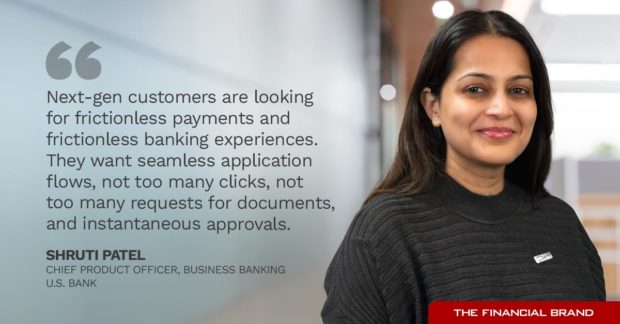
“Next-gen customers are looking for frictionless payments and frictionless banking experiences,” says Patel. “They want seamless application flows, not too many clicks, not too many requests for documents, and instantaneous approvals.”
Younger owners expect to be able to do things like opening accounts “within a few hours,” and they want to be able to do almost everything on the bank’s mobile app or online.
New products play into these needs.
One is a small business payroll solution introduced as an embedded service in business banking accounts. The new service resulted from a partnership with the fintech Gusto, which itself offers small business payroll, human resources and benefits services.
Patel says part of what makes development of such new services work is tapping the expertise of U.S. Bank’s innovation team to sort out the options available among developers and potential partners. Patel explains that her area worked with the innovation staff to compare offerings side by side for the best fit with the bank’s own technology and its small business customer base.
Among other new additions is a cash flow management platform that incorporates advanced bill pay capabilities with flexible payments options, accounts payable functionality and other elements. This was also put together through fintech partnership with Fiserv and Melio Solutions. Another new service, the Business Essentials account, expands small firms’ ability to accept card payments with a free mobile reader and free same-day access to sales proceeds.
Read more:
link